How to Measure Your Bra Size at Home
You only need a soft tape measure, a mirror, and five quiet minutes. Here is the method we use, step by step, plus the small mistakes that throw most measurements off.
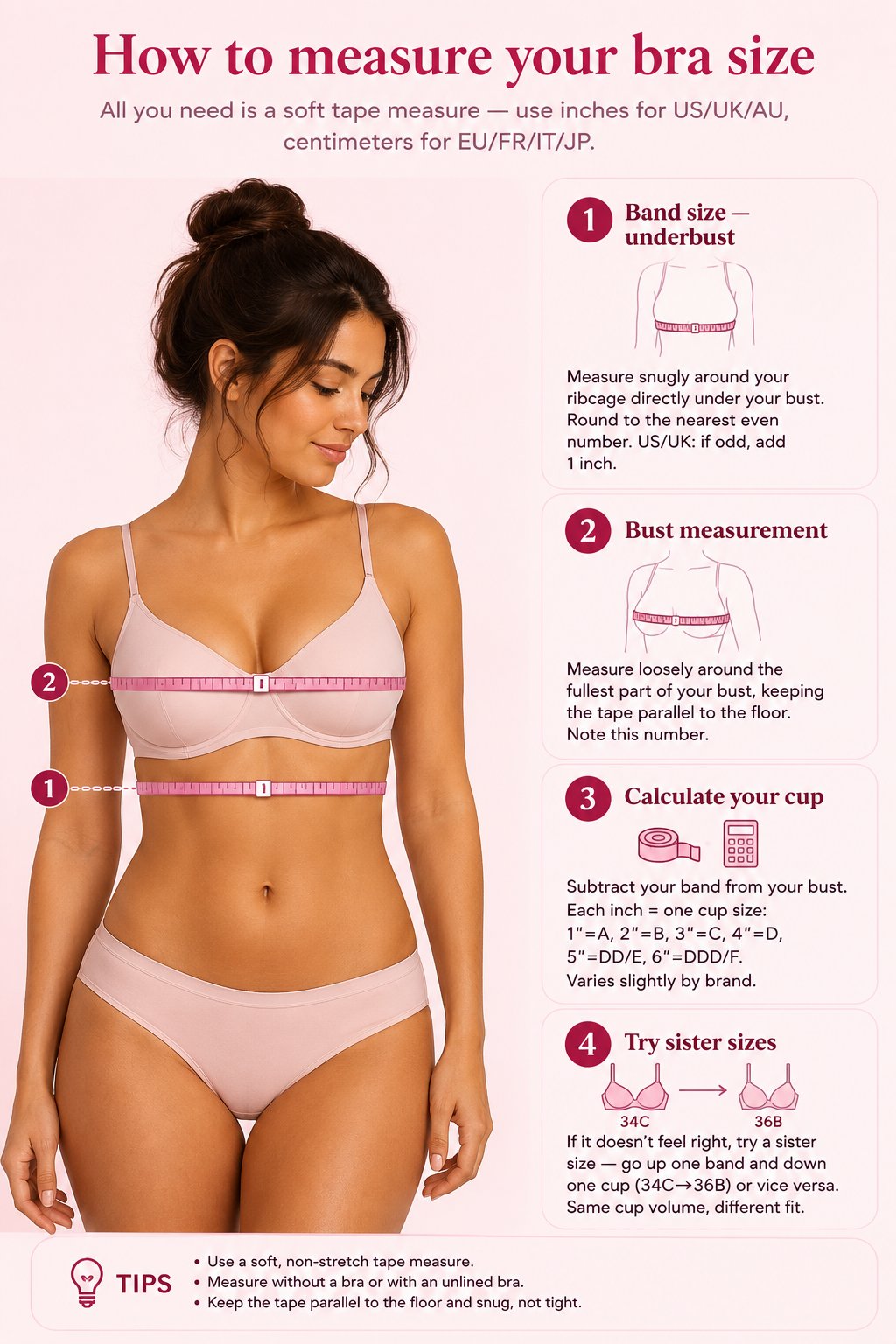
Most people have never actually measured their bra size. They were sized once, years ago, or they guessed, and they have been buying the same number ever since.
Bodies change, brands differ, and a five-minute measurement is the fastest way to stop fighting your underwear.
Here is the whole process. Read it once, then do it in front of a mirror.
What you need
- A soft fabric tape measure (the kind used for sewing). If you only have a rigid metal tape, use a piece of string and measure it against a ruler afterward.
- An unpadded, non-push-up bra, or no bra at all. A padded bra adds inches and will give you the wrong cup.
- A mirror, so you can keep the tape level.
Step one: measure your band
- Stand up straight and wrap the tape around your ribcage, directly under your bust, where the band of a bra sits.
- Pull it firm and level — snug enough that it would not slide down, but not so tight that it digs in. The band carries most of the support, so a firm reading here matters.
- Read the number in inches. If you land on a fraction, round to the nearest whole number.
That number is roughly your band size. Many older guides told you to add four or five inches to this measurement. Skip that step.
The "add inches" rule comes from a time when bras were made of stiffer, less stretchy fabric. It is the single biggest reason people end up in bands that are far too loose.
Step two: measure your bust
- Wrap the tape around the fullest part of your bust — usually across the nipple line.
- Keep the tape level front and back. Letting it droop in the back is a common error that shrinks your cup reading.
- Stay relaxed. Do not hold your breath or puff your chest. Read the number.
Step three: find your cup
Subtract your band measurement from your bust measurement. The difference, in inches, is your cup size:
- 1 inch → A
- 2 inches → B
- 3 inches → C
- 4 inches → D
- 5 inches → DD (E in UK sizing)
- 6 inches → DDD / F
- 7 inches → G, and so on
So if your underbust is 32 inches and your bust is 36 inches, the four-inch difference puts you at roughly a 32D.
Cup letters are relative to the band — this is the part most people miss, and it is why the same letter looks different on different bodies. We cover that in our guide on cup size myths.
Treat the result as a starting point
A tape measure gets you close, not perfect. Sizing varies between brands and even between styles from the same brand, so your calculated size is the size you walk into the fitting room with — not a verdict.
When you try it on, check the band, the cup, and the underwire against the fit signs in our guide on how to tell a bra does not fit.
If your size is sold out, you are not stuck. Learn how sister sizes let you shift band and cup together to find an equivalent fit.